Stay together around the clock
Stay together with your newborn baby day and night and keep as much skin-to-skin contact as possible. Your baby will feel secure and breastfeeding and the mother-child bond will be promoted in this way.

The mother’s body is her baby’s natural habitat. In direct physical contact, the mother can directly perceive her baby’s needs.

Babywearing is „the breastfeeding of fathers“. It offers the baby a sense of security and promotes the father-child bond.
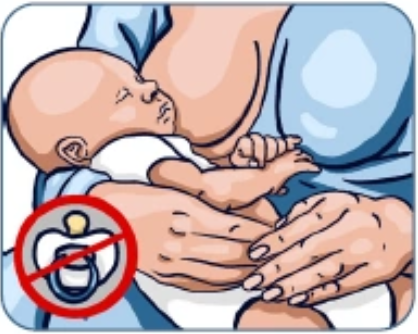
Soothe your baby by breastfeeding, skin-to-skin contact and carrying. To protect breastfeeding, refrain from using dummies and feeding bottles.
Attaching the baby
Latching in the prone position controlled by the baby (intuitive breastfeeding):
In the prone position, your baby can search for and grasp your breast on its own. To do this, lean back comfortably with good support and place your baby on your tummy in skin-to-skin contact. Support your baby intuitively.
The baby lies on the body of the mother:

It finds the nipple:

… and attaches:

Intuitive breastfeeding in videos:
Mother-controlled latching on:
Position your baby so that the entire front of its body is touching you, tummy to tummy. Support your baby’s back and the base of his skull and hold him so that your nipple is under his nose. When he opens his mouth wide to latch on, quickly pull him towards you with the chin leading so that he gets plenty of breast tissue in his mouth.
The nipple is held under the baby’s nose:
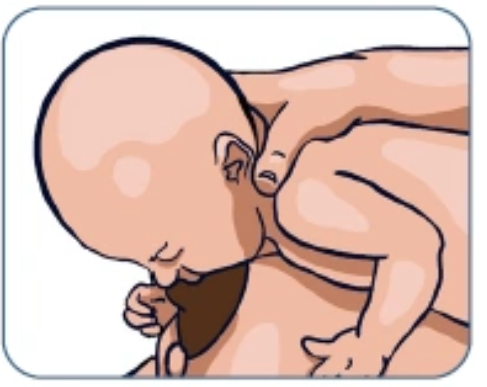
The baby opens its mouth wide:

At this moment, the baby is pulled up firmly and docks:
Mother-controlled feeding in a video:
Deep grasping of the breast
A well attached baby has its mouth wide open and grasps a lot of breast tissue.
Deep attachement

The baby’s mouth is wide open and catching a lot of breast tissue. Its chin sinks into the breast. The lower lip is turned outwards or covered by the cheek and breast. The head is tilted slightly backwards.
Superficial attachement

The baby takes too little of the breast, the mouth is less open, the chin often sticks out from the breast. Breastfeeding is painful and not very effective, the nipple can become sore.
Break the suction

If the latching is superficial and painful, break the suction by sliding your little finger over the corner of the mouth between the baby’s gums. Latch your baby onto your breast again.
Breastfeeding on demand

You can breastfeed your baby around the clock without restrictions, even at night. There is no minimum interval, no fixed breastfeeding rhythm required. No matter when your baby feeds again, after 1 or 3 hours or every 10 minutes: you can breastfeed again at any time.
In the first 6 months, babies feed at least 8-12 times in 24 hours. A breastfeeding session can mean one breast, both breasts, alternate breastfeeding or cluster breastfeeding, i.e. many short breastfeeding episodes in succession, depending on your baby’s appetite and interest.
The breastfeeding cues
Your baby will show you when it wants to breastfeed. Please, respond to the early and active feeding cues! Otherwise, some babies will go back to sleep hungry, others will be too hectic and won’t latch on as well. Crying is already a very late sign of breastfeeding. If you hold your baby in physical contact a lot, you will intuitively recognise the feeding cues early on. If your baby does not respond reliably, you can wake it up to breastfeed.
Early feeding cues

Licking, smacking, sucking, slightly outstretched tongue
Early cues in a video:
Aktive feeding cues

Restlessness, movement of head, arms and legs, whimpering, hand in mouth
Aktive feeding cues in a video:
Late feeding cues

Great unrest, crying
Breastfeeding positions
Familiarise yourself with different breastfeeding positions and try out which positions work best for you and your baby. Your preferences may change over time. For many newborns, breastfeeding in the prone position is the most stable and easiest.
laid back position (prone position):
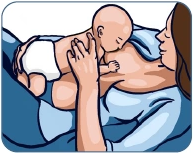
in videos (the same as intuitive breastfeeding):
Cross-cradle hold:
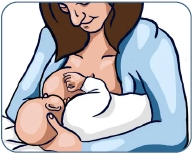
Videos from two perspectives:
Football hold:
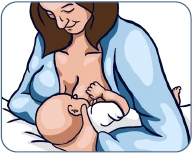
Videos from two perspectives:
Side-lying hold:
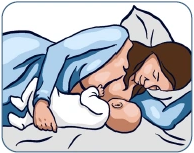
Videos from two perspectives:
Cradle hold:

Koala hold:

Videos:
Terms of use: This site is for your personal use only. The site and its contents (text, graphics, videos) are protected by copyright and may not be downloaded, copied, linked, distributed or passed on. Licensed partners of the Breastfeeding Lexicon (clinics, midwives, breastfeeding consultants, training institutes, universities, etc.) with a currently valid licence may exclusively show the site and its contents to their patients, clients or employees and also pass on the access data to them.